
A Book Review: Meditations by Marcus Aurelius (translated by Gregory Hays)
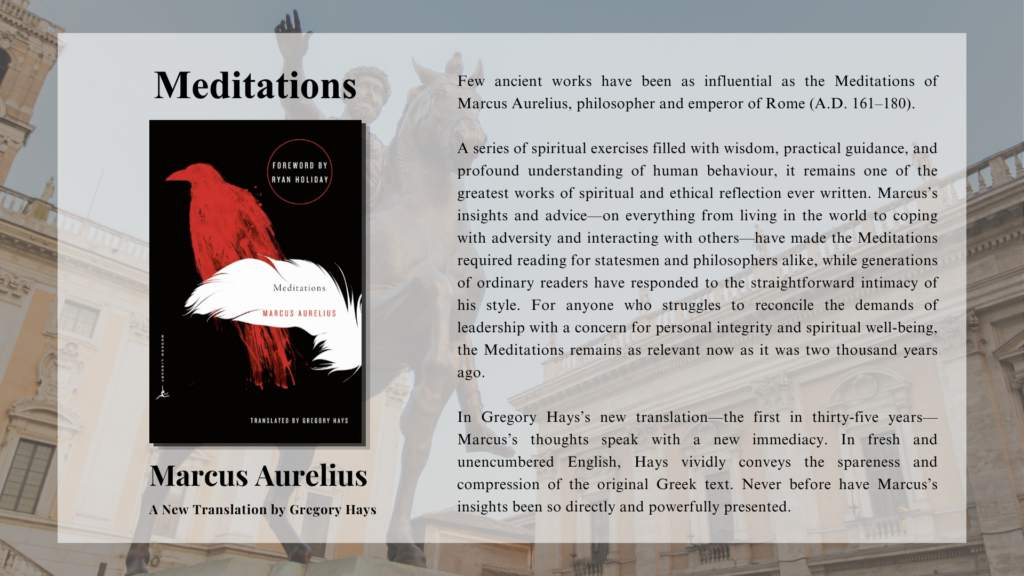
Few ancient works have been as influential as the Meditations of Marcus Aurelius, philosopher and emperor of Rome (A.D. 161–180). A series of spiritual exercises filled with wisdom, practical guidance, and profound understanding of human behavior, it remains one of the greatest works of spiritual and ethical reflection ever written. Marcus’s insights and advice—on everything from living in the world to coping with adversity and interacting with others—have made the Meditations required reading for statesmen and philosophers alike, while generations of ordinary readers have responded to the straightforward intimacy of his style. For anyone who struggles to reconcile the demands of leadership with a concern for personal integrity and spiritual well-being, the Meditations remains as relevant now as it was two thousand years ago.
I picked up my copy of Meditations after chancing upon the teachings of Marcus Aurelius during a stressful period of my life. Meditations is, in fact, Marcus Aurelius’s personal diary, a private record of his beliefs and reminders to himself. While the book doesn’t outright preach Stoicism, the philosophy was evident in his notes as he navigated the heavy responsibilities of being one of history’s most powerful emperors. In a way, like the rest of us, he was just a man trying to make sense of a chaotic world, and Gregory Hays’s translation makes his words easy to understand and relate to.
What it’s about
Rather than a structured treatise, the book is a collection of personal notes Marcus Aurelius wrote to himself as he helmed the empire. Each entry is a note on duty, mortality, patience, and how to remain firm and good in the face of chaos.
Passages that stood out
From Book Two:
Do external things distract you? Then make time for yourself to learn something worthwhile; stop letting yourself be pulled in all directions.
From Book Four:
Time is a river, a violent current of events, glimpsed once and already carried past us, and another follows and is gone.
From Book Five:
- The things you think about determine the quality of your mind. Your soul takes on the colour of your thoughts.
- So other people hurt me? That’s their problem. Their character and actions are not mine.
From Book Six:
Ambition means tying your well-being to what other people say or do. Self-indulgence means tying it to the things that happen to you. Sanity means tying it to your own actions
From Book Eight:
Epithets for yourself: Upright. Modest. Straightforward. Sane. Cooperative. Disinterested. Try not to exchange them for others. And if you should forfeit them, set about getting them back.
Keep in mind that “sanity” means understanding things—each individual thing—for what they are. And not losing the thread.
And “cooperation” means accepting what nature assigns you—accepting it willingly.
And “disinterest” means that the intelligence should rise above the movements of the flesh—the rough and the smooth alike. Should rise above fame, above death, and everything like them.
From Book Twelve:
It never ceases to amaze me: we all love ourselves more than other people, but care more about their opinion than our own.
My Thoughts
What makes Meditations a literary gem to behold even today is the intimacy of reading someone’s private thoughts and how timelessness and relevant his words felt, despite being written almost two thousand years ago. Hays’s translation only adds to this, rendering Marcus’s written thoughts in plain modern English rather than archaic prose, so the wisdom never feels distant or out of reach.
Stop talking about what the good man is like, and just be one.
I enjoyed and revered Meditations for its philosophical depth and the lens through which Marcus Aurelius viewed the world. Ultimately, it taught us about the fleeting nature of life, the beautiful limits of time (a subject I’m always intrigued by), and how to be a person who upholds justice and does good and perhaps, how to see the world as it is, void of extreme emotions, by mastering one’s own mind.
If you’re going through a difficult period, new to philosophy, or a fan of Stoicism, this is a book for you.
I also own a copy of The Wisdom of Marcus Aurelius, which makes for a succinct read for anyone looking for a quick daily dose of wisdom.




Comment
[…] Meditations (Things Unto Himself): A Masterclass to Life, Time, and Living Well […]