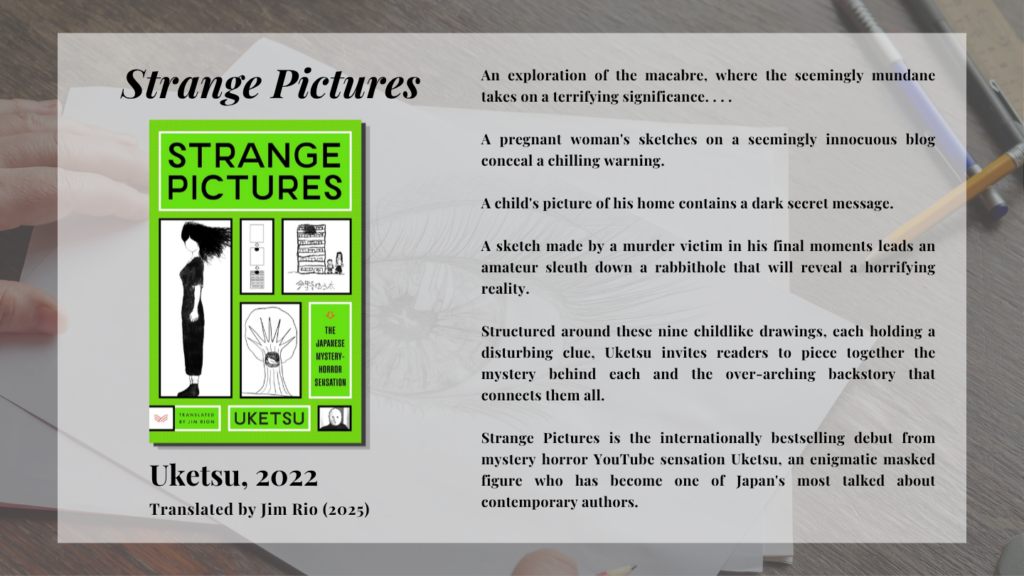
After finishing Strange Houses, I barely paused before picking up Strange Pictures. That is how compelling Uketsu’s works are. The good news for new readers is that the two novels are entirely standalone. Familiar characters make brief appearances, but there is no requirement to read them in any particular order. Each book holds its own tale.
Where Strange Houses unsettled me with architecture, Strange Pictures does the same with drawings. Once again, the illustrations are not decorative inclusions but active participants in the mystery. If you are the kind of reader who likes to pause, study a page, and feel the quiet dread of realising something is wrong before the text explains why, this book is for you.
Plot
Strange Pictures is a four-part Japanese novel built around a single overarching mystery. It opens with a psychoanalytic evaluation of a young girl whose drawing was used to determine whether she was ready to reintegrate into society following a brutal act of matricide. From that striking beginning, the narrative shifts across decades in a non-linear structure.
The threads include a bizarre blog titled Oh No Not Raku!, which documents a pregnant mother’s unsettling drawings, and a cast of characters whose stories gradually intersect. Red herrings are planted throughout, both in the text and within the illustrations themselves. Slowly, the answers get resolved, bringing a resolution to a mystery that spanned a lifetime.
Thoughts (spoilers ahead)
A strange and terrifying read.
Between the two novels, I found myself preferring Strange Pictures. The narration is sharper, the mystery is layered, and the use of child-like illustrations feels even more purposeful (cue eerie) here. The format remains accessible, a blend of interviews, dialogues, and descriptive narration, but the addition of a non-linear timeline gives the story a more complex quality. What initially feels disjointed eventually closes in on itself like a circle. The effect is strangely gripping.
The twist at the end was unexpected. Looking back, the child introduced in the opening chapter and the cold, indomitable woman revealed at the conclusion are the same person, and the transformation is chilling. That arc, once fully visible, reframes much of what came before.
The inclusion of drawing tests as a psychoanalytic tool was an absurdly clever narrative device. It creates a kind of interactivity for the reader, inviting us to interpret the illustrations alongside the characters and, in doing so, reflect on the deeper workings of the human psyche. The transitions between timelines, from university students discovering a strange blog about a pregnant woman’s mysterious death, to a child’s seemingly innocent sketch, to the final moments of murder victims, are intricate and carefully constructed.
Strange Pictures also reaches beyond the mystery genre to engage with broader themes. It touches on Japan’s social pressures, including the stigma surrounding divorce and the long shadow of child abuse, framing them as part of the murderer’s origin story. It is a heart-wrenching lens through which to understand a character’s choices, even as the novel makes clear that trauma does not justify the violence that follows.
This book offers no frustrating open endings. Instead, it closes with a settled, sombre sense of injustice for the characters who never made it alive. The mystery unravels at a measured pace, and the cumulative effect is deeply satisfying.
Final Verdict
Strange Pictures is a compact but hauntingly layered novel that rewards attentive readers. If you are drawn to visual storytelling, unconventional narrative structures, or mysteries with emotional weight, this is the book to start with.
Read my Strange Houses review here.
Recommended for: Fans of Japanese crime fiction, psychological thrillers, illustrated mysteries, and literary horror.
Have you read Strange Pictures? I would love to know what you made of the ending!
Comment
[…] the covers of the Strange Series (Strange Pictures and Strange Houses) caught my eye, Murder at the Black Cat Cafe did too. That was how I found my […]